











The Record Collector CDs
Samples can be played by clicking on the button beneath the description of each CD. See our back catalogue.
New Additions
TRC52
£9.95 ($19.00)
Every year we issue a CD retrospective of the singers who were the subjects of articles in the previous volume. In this way our readers can hear these singers at their best in rare, beautiful and often previously unavailable material. Many of the items are being issued on CD for the first time and several are receiving their first-ever reissue.
Click for more information…
Subscribers will be aware of the great contribution that Alan Bilgora made to our hobby but few will have had an opportunity to hear his singing. On the evidence of these two items Alan could surely have pursued a professional singing career, had he so chosen. He is joined by the London Jewish Male Choir, where his high-lying tenor voice is heard to great effect. Top Cs held no terror for him!
Lina Bruna Rasa’s pitifully small discography has largely already been reissued on CD. However, we wanted to represent her by at least one example. One of the best is the Mefistofele aria, where the exceptional colour, intensity and the life-giving, quick vibrato of her voice make her unique among the verismo sopranos of her day.
Why the records of Lionello Cecil are not more eagerly sought remains a mystery. His discs show an Italianate, bright-toned tenor of great range, wedded to a secure technique. His Manon is especially fine, with long-breathed phrasing and secure tone. Also noteworthy is the Puritani, sung in the original key, topped with a thrilling C sharp. It is just a pity that this last recording is marred by slight distortion from the early carbon microphones.
The recordings of Elza Szamosi are important rarities, so it is with great pleasure that we bring you this unique disc, an unpublished recording that seems to have been made for Frédéric D’Erlanger, the composer of Tess. We were unaware of the existence of this recording when compiling her discography for the article in Vol. 66, no. 1. She will not be the first artist whose discs fail to capture an exceptional tonal quality, but we know from the article that her career was of the first importance.
Who among us is not enchanted by the unique charm of Emilio de Gogorza? His is an example of the triumph of a great intelligence, vivid personality and a special elegance of style over a voice of slender resources. Whether, as here, singing in Italian, French, English, or even with a faux Irish accent, his art is always bewitching.
I can’t help thinking that the early recording apparatus failed to capture the special qualities of the voice of Emma Eames. Many of her discs do not convey the purity and particular vibrancy of tone that was surely obvious in the house. Although many of her discs have been reissued before, we have chosen two which we feel represent her at her best. The Tosca is intensely dramatic for a singer often accused of being ‘cold’. Almost the polar opposite, her Roméo et Juliette shows her lightening the tone and a skill in fioratura that reminds us that she was a Marchesi pupil.
Thanks to the generosity of Michael Seil, we are proud to bring you the first known recordings of Sena Jurinac, made privately in 1944 by the artist. These show the young voice, barely two years after her debut. There is a ravishing purity in her singing which is already at the service of an excellent technique. They are an important and previously unknown addition to her discography.
Kim Borg’s first 78s reveal a beautiful bass voice of considerable resonance and wide range. Contrast his oleaginous and intimating Barbiere with the dolorous dignity of Pimen’s Act 4 monologue. Borg was also a famous lieder singer, as exemplified by his magical ‘Erlkönig’. How he delineates the three voices yet still depicts the increasing anxiety of the child during the song shows an artist of the first rank.
Few collectors are familiar with the sensational tenor voice of Rafael Lagares. That epithet is richly deserved and is well shown by these rare Argentinian Victors. Though the singer’s style can be somewhat unrelenting, there is no doubting the sheer frisson of such a spinto voice in full cry. The recording quality is rather thin and over-reverberant but we hope that these records will make a welcome addition to our collections.

Lionello
Cecil Manon: 'Ah! dispar vision'
TRC50
£9.95 ($19.00)
Every year we issue a CD retrospective of the singers who were the subjects of articles in the previous volume. In this way our readers can hear these singers at their best in rare, beautiful and often previously unavailable material. Many of the items are being issued on CD for the first time and several are receiving their first-ever reissue.
Click for more information…
It is the magic of song which so often brings out the best in our favourite artists. Unencumbered by the constraints and tenets of opera, the song allows an artist’s love for the idiom and interpretative skills free reign. This certainly applies to Regina Pacini, whom Michael Aspinall praised for her passion and delicacy in song in his comparative article on her recordings. Here are two of her best: both Tosti songs, on which she lavishes the beauty of her voice and every accomplishment of the great singer.
Mario Chamlee was a fine artist who has been rather neglected even by collectors. A stalwart of the Met for nearly two decades, his voice could encompass both lyric and spinto roles with great versatility. Our choices here illustrate that. His Mignon aria is rendered with a lovely legato line and suffused with a beautiful mezza voce. More heroic is ‘Open the gates of the temple’. The voice rings out thrillingly throughout. The lovely Elgar song ‘Pleading’ has been little recorded and Chamlee embraces it with love and a spectacular long diminuendo at the end. He does not deserve the neglect.
The acoustic Columbias of Hina Spani are major rarities and have rarely been transferred. We bring you three, two of which are of arias that she never recorded again. We also wanted to include a short electrical record, the lovely ‘El majo discreto’, to illustrate the improvement that electrical recording brought to the beauty and vibrancy of the voice. Little wonder why she is a favourite artist.
I confess that I had hitherto disregarded Browning Mummery. Yet in searching out items for this CD we have been pleasantly surprised by the sheer quality of his singing. His ‘Che gelida’ is as fine as any, the tenor giving the aria in the original key and encompassing the high tessitura with ease, with a splendid, ringing top C. Contrast that with his controlled mezza voce and the lovely shaping of ‘My lovely Celia’. It is a pity that it was pressed at a time of HMV’s noisiest shellac.
Despite the poor recorded quality of Cecily Gleeson-White’s Pathé discs one can hear a fine singer at work. Indeed, it was Andrew Marsden’s fascinating article on her which illustrated that she was a most capable soprano, able to embrace a wide variety of roles. We have the pleasure of bringing you her total recorded output, none of which has been reissued before. She easily embraces the youthful exuberance of Nedda, Musetta and Marguerite, yet is able to give a fine interpretation of the hapless Santuzza.
The recordings of Paul Althouse show a voice of not inconsiderable beauty and one as steady as a rock. No wonder his association with the Met spanned so many seasons. He was its American Wagnerian tenor of choice and for that reason deserves the attention of collectors, yet so few of his discs have been reissued on LP and CD. His ‘Celeste Aida’ vies with the best versions, exultantly yet sensitively sung. He modulates the voice throughout and is sensitive to the text. His records should be in every collection.
Marguerite Sylva was the Zorika in the first American performances of Lehár’s Zigeunerliebe in 1911 and, as she recorded four excerpts from the operetta on Edison cylinders after the première, these examples of her singing chose themselves. Though the voice is hardly of the first rank her singing shows real charm and a vivid personality at work.
We complete the CD with three examples of the sensational baritone voice of Antenore Reali. His is a virile, heroic sound of a colour which is perfect for the many villainous baritone roles in opera. ‘Caruli’ is his only recording of a song and has not previously been reissued on CD because of its rarity. The La Gioconda duet is a lovely example of the young Prandelli though a little marred by Reali’s backward placement from the microphone. The role of the dark, brooding Michele is perfect for his voice and his interpretation of the great aria ‘Nulla! Silenzio!’ is almost frightening in its intensity with a thundering climax on a magnificent top G.
Hina Spani “El majo discreto”
TRC49
£9.95 ($19.00)
Every year we issue a CD retrospective of the singers who were the subjects of articles in the previous volume. In this way our readers can hear these singers at their best in rare, beautiful and often previously unavailable material. Many of the items are being issued on CD for the first time and several are receiving their first-ever reissue.
Click for more information…
The neglect of the baritone Mario Basiola, even among collectors, is iniquitous, certainly based on distinction of these two excerpts. They show a very beautiful lyric baritone, with a ravishing mezza voce and exemplary sense of style. The rarely-recorded L’Arlesiana aria is, for me, one of the great baritone records, boasting a superb technique and one of the easiest A flats on disc.
Olive Fremstad’s discography has been transferred to CD but we had to represent this fine soprano in two of her best recordings, transferred from a late UK pressing with relatively quiet surfaces. The ‘Ho jo to ho’ is a thrilling version and is among the best versions on 78 rpm disc
Evelyn Scotney, for me, is a treasure and, again, sadly neglected. This lovely singer, among the last of the Marchesi pupils, is equal to the best of the school. Her ‘Bird in the Wood’ compares well with the more familiar versions by Selma Kurz, with equally phenomenal, even and long-held trills. It is also a pleasure to make available, for the first time, these two unpublished recordings. Both show her beautiful voice and excellent technique at their best.
Gabriel Soulacroix is an exemplar of the finest of the French school of baritones. His records show a gorgeous voice wedded to an exemplary technique that rewards careful listening. Here are two of his best recordings demonstrating his command of legato and rubato. It is perhaps a pity that much of his discography contains music of lesser worth but the best of his output is to be cherished.
The records of Victoria Fer are a perfect example of the axiom ‘the joy of our hobby is in discovery’. Prior to the comprehensive article on her by Frédéric Fuochi in the December issue of Volume 64, few had heard of her, yet it depicted an artist of the first importance. Her records are very hard to find and invariably turn up worn. Her ‘Voyons, Manon’ shows a lovely voice and a great artistry at work.
Few would describe the voice of Charles Gilibert as one of the greatest but there is no doubting the excellence of his technique and the musicality of this important singer. His ‘Plaisir d’amour’ demonstrates his command of line and his excellent trill. It is also charming to hear his speaking voice, introducing the traditional French song ‘Margoton’.
I believe that Carolina White was a far finer singer than her dull, acoustically-challenged and surfacy Columbias suggest. In mastering her records we strove to avoid cutting into the overtones of the voice by removing too much of the surface noise. Here are two of White’s best Columbias, demonstrating her rock-steady production and the flame-like intensity of her top notes.
When we published the discography of Jean Riddez we did not know of the existence of four electrical recordings, made in 1930, when the baritone was 55. Although this beautiful Massenet song reveals a voice that is a little past its best it is still an attractive sound with an approach that is stylistically perceptive.
Another disc that eluded the discography of Lilian Blauvelt in Vol 64 no 2 was the Messiah ‘Come unto him’. The disc is a Columbia with a superimposed Manhattan label. As with Carolina White the singer suffers from the poor acoustic of the Columbia recording process at that time.
A letter in Vol. 64 no 4 pointed out that the very rare Olimpia Boronat’s matrix 1769½L ‘Sempre libera’ is missing from the Marston ‘Complete Boronat’ issue. It has probably never been transferred to CD, so we have pleasure in bringing it to you here. It is another example of her stunning vocalism and explains why she has always been a favourite among collectors.
Because of the popular appeal of his films the serious side of Nelson Eddy’s art has been somewhat overlooked. That he was rather a far greater singer than many realise is amply demonstrated in these two items. His Aleko aria displays a virility of tone and attention to text in one of the most beautiful of arias in the baritone repertoire. The Martha aria shows his fine breath control despite the somewhat showy approach no doubt demanded by the film’s plot.
We finish this eclectic collection with two recently found radio acetates, of Eva Turner and Norman Walker. ‘The Star’ is not a particularly interesting song but it is good to have an addition to the great dramatic soprano’s recorded repertoire even if, by this time, the tone appears to have hardened a little. That Norman Walker was an excellent Handel singer is without doubt. ‘Honour and Arms’ is superbly sung, displaying manly tone, accomplished coloratura and an ease in the high tessitura of this difficult aria.
Mario Basiola L’Arlesiana ‘Come due tizzi accesi’
TRC48
£9.95 ($19.00)
Every year we issue a CD retrospective of the singers who were the subjects of articles in the previous volume. In this way our readers can hear these singers at their best in rare, beautiful and often previously unavailable material. Many of the items are being issued on CD for the first time and several are receiving their first-ever reissue.
Click for more information…
It is difficult to understand the neglect among collectors of the recordings of Ludwig Hofmann. They show a magnificent, black, bass voice, ideally suited to the Wagner repertoire. Yet, he was also a superb interpreter of other fachs, as these examples show. Surprisingly this Faust excerpt has never been reissued on CD.
The ethereally beautiful soprano voice of Anna Case is perfectly captured on her Columbia discs. The Semele aria is exquisitely delivered, the voice perfectly poised and ravishing in sound. ‘The Night Wind’ is evocative and the charming Victorian rolled ‘R’ reminiscent of a bygone era.
Clarence Whitehill is another fine artist whom collectors have tended to overlook. That is a pity, as the records show a voice that is resonant and well-produced. His Met career alone, from 1909 to 1932, indicates an artist of importance. These three examples show his art at its best, with his perfect enunciation of sung text and dramatic sensibilities.
The Record Collector is delighted to present the so-called Aramburo/Masini G&T, which originally appeared on an EJS LP many years ago. This track is a direct dub from the original in the collection of Bob Ziering, in superior sound to the LP and accurately pitched for the first time. Unfortunately, the disc runs out just before the end of the aria. The recording shows a voice that is no longer young, but the aria is sung with great sensitivity and pathos. The collecting world is indebted to Bob, and Will Crutchfield, who arranged the dubbing of this unique record, thereby making it available for future study.
The records of the French mezzo Louise Berat are great rarities and show a warm, attractive voice. Her records are certainly worthy of our attention. Although she was primarily a comprimario she sang with all the greats. The ‘Frileuse’ is just a trifle but it shows a real personality at work.
Here are three further titles of the great Charles Rousselière, not included on TRC46, which was devoted to this fine tenor. It is obvious from his discs why he was a star of the first importance and these show further aspects of his art. Especially noteworthy is the aria from Massenet’s Ariane from one of his very rare Eden recordings. His approach is heroic, yet he could also sing with lyric beauty, as shown in the Martha aria.
For most collectors the name Jeanne Tiphaine was unknown. Hence, it is a pleasant surprise to discover a singer with an important and very beautiful voice. Her career spanned more than fifty years at the Opera-Comique, yet the great rarity of her records belies her fame. The voice is an attractive, light soprano and her Beka recording of the Louise aria vies with many more famous versions.
Another neglected artist is the lovely soprano Elsa Bland. She was a major star with Mahler’s ensemble in Vienna, and her discs demonstrate a beautiful lirico spinto voice of great power. Her records are difficult to find in good condition. We hope that these three will remind listeners just how good she was.
The late, much-lamented Jim McPherson wrote lovingly of the contralto Kathleen Howard. Again, mainly a comprimario, she was nonetheless a fine singer and is worth collecting. It is a great shame that she recorded only for Edison and Pathe for the voice is an attractive one and a real personality is evident.
Few would call Giullo Crimi’s voice beautiful, but it is obvious why he had a fine career. Its sound is bright, incisive and powerful, capable of cutting through any orchestra. His discs show why he excelled in the high-lying, taxing roles of Mascagni and Giordano, as well as those of Verdi and Puccini. He has been somewhat overlooked on CD, so it is good to have these three examples of his spinto tenor. His ‘Addio alla madre’ is especially fine.
Paolo Silveri was a fine baritone who enjoyed a long and important career. Hence, it was fascinating to read Alan Bilgora’s assessment of his discs in which he opined that his commercial recordings do not reflect the quality that struck the listener in live performances. We are pleased to present two radio recordings, which show him at his best, which is quite magnificent. His Figaro is resonant and fleet of foot and Ribetti is a capricious and technically fine partner. His ‘O Carlo ascolta’ is towering in its intensity. A moment of interval radio interference just before end of the aria does not detract from this superb recording.
Paolo Silveri: Don Carlo ‘Per me giunto’. Live excerpt from radio 1948
Click to play a sample
TRC47
£9.95 ($19.00)
Every year we issue a CD retrospective of the singers who were the subjects of articles in the previous volume. In this way our readers can hear these singers at their best in rare, beautiful and often previously unavailable material. Many of the items are being issued on CD for the first time and several are receiving their first-ever reissue.
Click for more information…
If there was ever a reason why each collector should be willing to listen beyond the grandi nomi it would be some of the superb performances on the AFRS transcriptions. Otherwise they would miss the phenomenal singing of the hardly-known Francine Falkon in ‘O prêtres de Baal’. The voice and technique overcome the demands of this challenging aria with ease. Yet, to the best of our knowledge, she never recorded commercially. Nor would they have been introduced to the granite-like bass of Norman Scott, whose oleaginous ‘La calunnia’ is among the best of versions and capped with a thundering top G. He would surely have become better known, had he not died tragically young. Outstanding, too, is the wonderful, introspective version of ‘Pari siamo’ by Clifford Harvuot, with its myriad colours, inflections and exemplary line. If the style of Thomas Hayward is a little forthright in his ‘A te, o cara’, there is no denying a fine tenor voice with an easy top C sharp which would have been an asset to any company.
We were pleased to present a biography and discography of the very fine contralto Margarete Arndt-Ober in Volume 62, no 3 for she is a patrician artist who is desperately underrated by collectors. Many of her records are very fine and show a sumptuous contralto voice of great range. Among the best is the duet from Boris with Althouse, where her ravishing tone is especially well caught. This proved a difficult recording to master as it is heavily recorded and the final notes have a tendency to blast, despite the mint copy used.
Sara Scuderi was among the last of a line of great verismo sopranos. Her short discography is to be cherished as her records show a very beautiful voice allied to a passionate delivery of text. ‘In quelle trine’ is especially fine for its ardour, the voice throbbing with emotion while still maintaining a smooth legato. She deserves greater appreciation.
The records of Avelina Carrera are hardly ever encountered. Her reputation is preserved by a short discography which contains many unpublished recordings. She shares much in common with Scuderi, both in repertoire and voice. Her discs reveal a lovely sound, the voice used with great intelligence.
It is a privilege to present an example of the opulent contralto voice of Tilly Koenen, an artist completely forgotten today. At a time when contraltos recorded least well of all voices it is still evident that here is a sound of great purity and beautiful tonal quality.
The records of Petar Raichev are highly sought after by admirers of fine tenor voices. The sweetness of its timbre and his fine technique are beguiling, especially in the two arias from Barbiere, which owe much to the influence of his teacher De Lucia. Yet he can summon sufficient metal to cope with the spinto demands of ‘Ah! Non mi ridestar’ when required. It is amusing how, at times, he sounds remarkably like his contemporary Joseph Schmidt. Less to be admired is the garbled enunciation of Italian in some of his recordings, despite his important Italian career.
It was difficult not to fall under the temptation to fill this CD totally with the recordings of the delightful Leïla Ben Sedira. Her records reveal a voice of ravishing beauty with a personality that just leaps from the groove. Here are three of her best. They show both her skill in coloratura and her endearing charm. In a simple song such as ‘Roses de Picardie’ her lovely sound is quite bewitching.
Alfred Orda possessed one of the most beautiful baritone voices of all time, with a colour that was unique. He recorded very little and Richard Copeman’s article in Volume 62, no 2 shows that the artist himself did not help his career by being difficult and demanding. This record was a recent discovery on the strange Musette label: the matrix number is missing and the date of recording is unknown. The recording is poor, but every one of Orda’s few discs is to be cherished. This lovely Chopin song was likely to be a staple of his repertoire and shows well the sheer beauty of the voice.
‘Magisterial’ seems an appropriate epithet to describe the voice of Helen Traubel. That quality is aptly demonstrated in these three unpublished Columbias. ‘Die Trommel gerühret’, sung in English as ‘The drums are loudly beating’, shows the sheer ring of the sound, contrasting with ‘Wiegenliedchen’, which is sung in a lower register of contralto-like intensity. Then, to end the CD, her ‘Cäcilie’ illustrates the authority and grandeur of the sound that thrilled Met audiences for nearly two decades. While mastering the three discs the reason for their non-publication became clear: there is an almost imperceptible distortion in the recording. Despite their technical shortcomings it is good that they can be heard at last, because the singing is superb.

Leïla Ben Sedira 'Les Roses de Picarde'
Click to play a sample
TRC45
£9.95 ($19.00)
Every year we issue a CD retrospective of the singers who were the subjects of articles in the previous volume. In this way our readers can hear these singers at their best in rare, beautiful and often previously unavailable material. We believe TRC 43 (Volume 58 singers) to be one of our most ambitious issues to date. Not only are many of the items being issued on CD for the first time but several are receiving their first-ever reissue.
Click for more information…
When one listens to Alessandro Granda, one cannot help coming to the conclusion that, surely, this was one of the great voices of the 20th century. The sound is powerful, ringing and with a splendid top. Yet, he has been almost completely forgotten, even among collectors. Let us hope that these four examples will help redress that balance. Listen to how easily he rides the high tessitura of the two difficult arias from Iris!
The voice of Max Dawison is a real discovery. His rare records show a sound that is ringing, unforced and handsome in tone. Gifted with a fine top, Dawison exploits an opportunity to interpolate an unwritten top G in the aria and cabaletta from Lucrezia Borgia, which is unfortunately squeezed on to one side of an Odeon disc but is still a fine example of his art.
The verismo soprano, a species once relatively common, is now, regrettably, extinct. Francisca Solari was typical of the type: a superb, spinto soprano with a flickering vibrato and easy high notes, entirely at home in the music of Giordano and Mascagni. Her discography is a tragedy as she was recorded only in excerpts from Parisina and Isabeau despite her large repertoire of roles. Until now her fine Isabeau recordings appear to have escaped the attentions of reissuers.
Examples of the recordings of Jeanne Marié de l’Isle should be in every record collection. The voice is a ravishingly beautiful mezzo, yet, although she was of the first importance, she is unknown to many collectors. With a few exceptions, her records are very hard to find and, when they do turn up, are inevitably worn, indicating that they were much enjoyed by previous generations.
Nobody would describe the voice of Frederick Ranalow as a great one but his records make enjoyable listening. His success in musical comedy and operetta is obvious from these examples: a real personality leaps from the grooves. These two songs show him at his best, with every word enunciated with perfect clarity.
We have great pleasure in bringing you the first-ever reissue of the unpublished disc made for the Gramophone Company of Hariclea Darclée. Thanks to the generosity of René Seghers, the author of the forthcoming book on the soprano, we present one of the songs from this disc (the second will have to wait for the publication of the book!). Though it is an intriguingly short 40 seconds in length, and of trifling music, we hear an obviously attractive soprano voice of a lovely colour.
Why has Louise Homer been so neglected among the collecting community? Here is an artist of the first importance, who enjoyed a long career singing with all the greats of her time. Her recording of the Le Prophète aria shows her at her best: the voice is huge, yet of great agility and with an easy, effulgent top. The best of her records are well worth seeking out.
I had never considered Jeanette MacDonald as a serious opera singer until John Banks’s interesting article appeared in Vol. 61, no. 4. Here are two of John’s choices to represent the soprano. In the lovely Louise aria the tonal quality is attractive and well-controlled. The mawkish, over-orchestrated recording of ‘Land of Hope and Glory’ will bring a smile to some listeners but there is no doubt about the sincerity of the singing, which is crowned at the end with an easy top C.
Charles Friant was a mastersinger. With a voice of relatively slender resources he could create magic with whatever he sang, combining a superb technique, a mastery of light and shade, of legato and a consummate use of rubato. The tone is always of the most beautiful colour and his records are models of an outstanding singer at work. All of these four selections show complementing examples of his art but I believe that the Prince Igor is the finest of all: one of the greatest of tenor recordings. Nearly so is the very rare May Night (Le Nuit de Mai) but it is afflicted by a very rushed tempo in an attempt to cram the aria on to one side of a 12-in. disc. If only the recording could have occupied both sides Friant would surely have been able to cast his magic yet again. He is an artist whose recorded output should be cherished.

Alessandro Granda Iris
'Or dammi il tuo braccio'
Click to play a sample
TRC42
£9.95 ($19.00)
We believe that this is one of our most interesting issues to date. Most of the items are being issued on CD for the first time and some are receiving their first-ever issue.
Click for more information…
The three examples of Tano Ferendinos show his sweet tenore di grazia to perfection. The ‘Torna’ is especially significant as he never recorded this song commercially. The two songs are charming and appear to have been omitted from other reissues on CD.
Louis Graveure’s voice is not to everyone’s taste and it is ironic that some of his worst discs seem to be the ones which are found most commonly. Yet at their best Graveure’s records show an interpreter of songs who is a born communicator, whose enunciation of the text is always crystal-clear. The ‘Yeoman’s Wedding Song’ is sung in ringing tones and is as fine an example of virile baritone singing as one could hope to hear. In more intimate music his mastery of mezza voce, rubato and diminuendi is second to none and the personality of the singer is always to the fore. For me, the best of his recordings are well worth seeking out.
No-one would suggest that Olga Haley was of the first rank of contraltos. Yet she is a fine artist who enjoyed great popularity throughout her career. Her records are certainly well worth hearing. Her Vocalions are difficult to reproduce, often suffering from heavy surfaces and backward recording. In the lovely ‘Harvest of sorrow’ her singing is both heartfelt and impassioned. The Dido is a strange arrangement of the music but her legato is a pleasure and the delivery ardent.
Giuseppe Taccani was, without doubt, one of the great lirico-spinto tenors of the 20th century. His discs always demonstrate a youthful and incisive tone and a security of attack that is thrilling, so it is a pity that he made relatively few recordings. The Jana disc is from the first session for the Gramophone Company in 1907 and is accompanied by the composer. The 27-year-old tenor is in fine form, ending the aria on an exciting B flat. The acoustic ‘Di quella pira’ is much harder to find than the electrical version and it has the advantage that the aria is in C (the electric recording is transposed down a semitone).
Emil Pinta’s article about the all-but-forgotten Pilotone label (Vol. 59, no. 2) was a great surprise, particularly as it revealed hitherto unknown recordings of several singers, among them Anne Roselle. The great Hungarian soprano, though nearing the end of her career at the time, is hardly taxed by the relatively trite, though rhythmically infectious, music. However, it is an example which admirers of this fine singer will want to have somewhere in their collection.
We are pleased to bring you three examples of the great Swedish tenor Set Svanholm. The Mendelssohn is from his first recording session and was recorded while he was officially a baritone. ‘Ich grolle nicht’ and the Meistersinger are previously unpublished. The voice in the Lied is still very baritonal but the easy, clarion top ‘A’ in the phrase ‘die dir am Herzen frißt’ (which most baritones eschew) shows the wisdom of his decision to change vocal registers. The Meistersinger is the unpublished take 2.
While researching which of the many Miguel Villabella records to include on this CD, I was surprised at how few of the Pathés had been previously reissued. The answer is probably because, with some exceptions, the recordings are poor, sometimes strident, sometimes distorted and we have worked hard to show them at their best. But they are important because they contain arias and songs that he never otherwise recorded and they show him at his best, such as the charming ‘Assis au pied’, which illustrates his beautiful head voice and the demi-teintes for which he was famous. The two arias from L’Illustre Fregona are creator’s discs and both are very beautifully sung. The music repays repeated listening. Each of the examples here has much to offer and illustrates one of the most interesting ‘French’ tenors of his time.
Click to play a sample
Miguel Villabella excerpt from Le Postillon de Lonjumeau
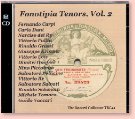
TRC41 - Fonotipia Tenors, Vol. II
Price £22.95/€30/$39
This is the second volume to the very successful issue of Fonotipia Tenors. As for the previous issue this is also a 2-CD set. Here are even more of the superb tenors who recorded for this preeminent company, which set the standards for technical quality of recording.
Click for more information…
CD 1: ACOUSTIC TENORS
FERNANDO CARPI
1. Mefistofele: Giunto sul passo estremo (Boito)
XPh 4968 16 Oct. 13 69167
2. Il Barbiere di Siviglia: Ecco ridente in cielo (Rossini)
XPh 49822 6 Nov. 13 69099
3. Il Barbiere di Siviglia: Se il mio nome (Rossini)
XPh 4984 8 Nov. 13 69100
4. Don Pasquale: Sogno soave e casto (Donizetti)
XPh 4989 11 Nov. 13 69102
5. La Traviata: De’ miei bollenti spiriti (Verdi)
XPh 4965 16 Oct. 13 69168
CARLO DANI
6. Don Pasquale: Com’ è gentil (Donizetti)
XPh 2321 15 Jan. 07 39966
7. Manon Lescaut: Donna non vidi mai (Puccini)
XPh 2338 17 Jan. 07 39959
8. Rigoletto: Questa o quella (Verdi)
XPh 2290 11 Jan. 07 39958
9. Rigoletto: La donna è mobile (Verdi)
XPh 2291 11 Jan. 07 39957
NARCISO DEL RY
10. I Puritani: A te, o cara (Bellini)
XPh 3678 26 Nov. 08 92375
11. Lucia di Lammermoor: Tu che a Dio spiegasti l’ali (Donizetti)
XPh 3694 28 Nov. 08 92370
12. Don Pasquale: Cercherò lontana terra (Donizetti)
XPh 3686 27 Nov. 08 92371
RINALDO GRASSI
13. L’Africaine: Mi batte il cor .... O Paradiso (Meyerbeer)
XPh 3550 21 Oct. 08 92262
14. Mefistofele: Dai campi, dai prati (Boito)
XPh 3559 23 Oct. 08 92261
GIUSEPPE KRISMER
15. Die Meistersinger von Nürnberg: Nel verno al piè focolar (Wagner)
XPh 3854 23 Apr. 09 92487
16. Die Meistersinger von Nürnberg: Cominciam! Appena il mite april (Wagner)
XPh 3953 19 June 09 69054
17. Die Meistersinger von Nürnberg: Dell’alba tinto (Wagner)
XPh 3855 23 Apr. 09 92488
18. Donna vorrei morire (Franchetti)
XPh 3973 23 June 09 92593
GUIDO VACCARI
19. Der Freischütz: Lieto il colle....La finestra s’apre (Weber)
XPh 1708/9 15 Mar. 06 39523/4
RINALDO SCHENONI
20. Die Walküre: Siegmund heiss ich (Wagner) (in Italian) w. Giuseppina Baldassare-Tedeschi
XXPh 5299 1 Dec. 22 74230
VITTORIO RÈ
21. Loreley: Infranto ogni altro vinco (Catalani)
XXPh 5266 8 Dec. 21 74220
22. Loreley: Nel verde maggio (Catalani)
XXPh 5265 5 Dec. 21 74219
SALVATORE POLLICINO
23. Andrea Chénier: Un dì all’azzurro spazio (Improvviso)
XXPh 5374 29 Oct. 23 74235
24. Nerone: Queste ad un lido fatal (Boito)
Pho 54462 ? Sep. 24 152594
25. Nerone: Decurione! e invan mi danni w. Ines Lombardi
Pho 54493 ? Sep. 24 152595
No exact recording date is specified in the Fonotipia registers for these last two matrices.
Playing time: 77 mins
Click to play a sample
Vittorio Lois excerpt from Guglielmo Tell
TRC40
£9.95 ($19.00)
Every year we issue a CD retrospective of the singers who were the subjects of articles in the previous volume. In this way our readers can hear these singers at their best in rare, beautiful and often previously unavailable material. We believe TRC 40 (Volume 58 singers) to be one of our most ambitious issues to date. Not only are many of the items being issued on CD for the first time but several are receiving their first-ever reissue.
Click for more information…
Who among us can resist the glorious voice of Pavel Lisitsian? His baritone was of a gorgeous tonal quality wedded to a perfect technique. It is difficult to believe that his Pagliacci ‘Prologue’ has hardly been reissued so, appropriately, it begins this CD. The live Aleko shows that, at 60, his voice was still in perfect shape. It is an important addition to our collections because Lisitsian never recorded the aria commercially. How marvellous that it has been preserved for our enjoyment! The Demon arias, also hardly ever reissued, are edgy, crude recordings typical of some Russian discs of the period. However, the magnificent singing always wins through.
Torsten Ralf’s acoustic Parlophons are of great rarity. They were intended only for the Swedish market and, even there, have not been reissued. They show a bright, youthful sound, but already with an incisive quality surely indicative of the direction in which his career would progress.
We thought collectors would want to hear Victor Maurel’s very rare take of ‘Era la notte’. This is take 2, whereas most reissues on LP or CD have used take 3. He is in slightly croakier voice here, but the long, dreamy mezza voce of ‘Desdemona soave! Il nostro amor s’asconda’ is sustained even more magically than on the third take. Collectors will compare the two versions for themselves. It was just a pity that there was not enough room on the CD to include both takes side by side.
Sydney Rayner is represented by three of his rare Sonabels. He was never a subtle singer and rarely modulated the voice, but the forthright, rock-solid technique and the sensational top are qualities to admire. The two Tosca arias are very well sung, while ‘Canta pe’ me’ shows him in a more relaxed mood. He brings a touch of real Mediterranean sunshine to this lovely song.
Perceval Allen’s large discography is full of material unworthy of her great talent, so it is a pleasure to bring you these three Elektra recordings, which show her at her best. They are historically important as they were recorded less than three months after the première of the opera in Dresden. They are surely the first recordings of the new work and would hardly have sold in great numbers. Hence, they are of great rarity. They show a real dramatic soprano, with an incisive, brilliant tone and perfect attack. These three of the four excerpts that she recorded from the opera have never been reissued anywhere. What a pity that we simply couldn’t find the fourth!
Here are four examples of Dino Borgioli which demonstrate what an elegant, musical singer he was. The two acoustic Columbias are among the best versions of these arias. The two acetates show that he was still in fine voice some 30 years into his career and it is remarkable to note how little the voice has changed. The lovely Falconieri song was a favourite recital choice of the tenor and it is beautifully sung. The Matrimonio Segreto is rather backwardly recorded but well worth hearing. He was surely an artist to treasure.
Joseph Jamet, a bass of the first importance, was born in 1832 and is one of the oldest singers to have left his voice to posterity. This extremely rare disc is something of a curiosity, but there is enough tonal quality left for the ear of faith to reconstruct how he might have sounded in his prime.
Few would suggest that Gösta Björling was as gifted as his older brother Jussi. Yet it is an attractive voice, so reminiscent of Jussi’s, which he uses well. Because he was largely content to stay in Sweden he is not as well known as his famous sibling and, hence, fewer collectors know his recordings. They are well worth hearing.
I could not resist ending this CD as it began, with the voice of Pavel Lisitsian. The song is about the well-known story of Don Juan serenading an attractive young woman with the intention of casting his usual amorous spell. With such a voice, few maidens could resist!
Click to play a sample
Pavel Lisitsian except from Pagliacci
TRC38
£9.95 ($19.00)
It is our pleasure to present another compilation of the rare, the unpublished and the beautiful. As always, The Record Collector has avoided duplication with other reissues wherever possible.
Click for more information…
Conrad Thibault possessed, for me, one of the loveliest of baritone voices. It is always used with great sensitivity for both word and music. His singing displays all the graces of bel canto, wedded to a superlative technique. We are delighted to present here his test record for Victor. On the evidence of this gorgeous sound it is hardly surprising that Victor snapped him up quickly.
Maria Galvany’s style of singing probably, to modern ears, belongs to a bygone era. Here we present two titles which find her on her best behaviour. The Fado was written especially for her by the composer and is a most attractive example of her voice.
We have sought out the rarest of Charles Dalmorès’s output. Both of these titles belong to the earlier, and much rarer, Victor session of 1907. The Carmen is a fine recording, in which he sings with great passion, grace and style. One would have thought that the aria would have suited him but I confess that I found ‘Ah! lève-toi, soleil’ rather disappointing. The voice is in fine shape but the approach is muscular rather than romantic.
Edna Thornton is desperately underrated by collectors. If these recordings were in the original languages they would be highly sought-after as examples of great singing. The ‘Brindisi’ can vie with the best of them, with its superb coloratura technique and an excellent trill. In the ‘Ai nostri monti’ she moulds an exemplary legato line and it is also a fine example of the much undervalued tenor Walter Hyde. Thornton sang with all the greats at Covent Garden and her recordings more than repay careful listening.
I had not previously heard any recordings by Anton Moser owing to their great rarity. Hence, it is with great pleasure that we can represent this baritone in both opera and lieder. The voice has an attractive, bright, lyric sound. He deserves to be better known.
Nicola Zerola has been much ignored by collectors and we hope that these examples will redress that. The voice is trumpet-toned, with a superb top, but it is also a very attractive sound in its own right. The Otello aria shows why his interpretation of the role was so highly valued. His recording of ‘Meco all’altar’, with the cabaletta squeezed on to a 12-inch disc, is of great rarity and shows an important voice of great authority. His Aida recording is an object lesson in how to depict a hopeless situation by scaling down a large spinto voice to a caressing mezza voce.
Were it not for broadcasts the voice of the American bass-baritone Julius Huehn would have been lost to us forever. Thanks to this 1940 broadcast we can enjoy this heldenbariton, who sings with great beauty, tenderness and authority.
Finding excellent examples of the lovely voice of Eleanor Jones-Hudson gave us much difficulty. Her records usually turn up in poor condition, indicating the great enjoyment they have given their owners over the years. We feel we have done her justice with these three. Hers is a voice that is perfectly placed, of ethereal beauty and used with a fine technique. Her charm positively leaps from the grooves!
Most of César Vezzani’s recorded output has been reissued on LP or CD but here are three that have not yet been released on Marston’s ‘complete Vezzani’ project. They show the visceral excitement of that voice at its best with its thrilling vibrancy and ringing top. Outstanding among these is his recording of ‘Les millions d’Arlequin’. It was undoubtedly a voice that had to be worked, yet he sings this lovely song with a caressing half-voice throughout. The beautifully placed and held G with which he ends the piece lingers long in the memory after the music has faded.
Click to play a sample
César Vezzani 'Les millions d'Arlequin' (Drigo)
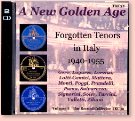
TRC32 - Forgotten Tenors in Italy 1940-1955, Vol. 2 (2-CD set)
£22.95 ($30.00)
The Record Collector is proud to present a 2 CD set of recordings of some excellent tenors who were active not only in the theatre but also on radio in Italy during the period 1940-1955. Their names, with only a couple of exceptions, are rather less well-known than those select few who managed to achieve international recognition. Most have never been transferred either to LP or CD.
Click for more information…
Many discs issued in Italy during this period and in the dying days of 78 rpm recordings have be extremely hard to find. In some instances they have proved to be of greater rarity than those earlier now historic recordings made in what has become euphemistically referred to as the 'Golden Age of Singing'. These are truly 'collectors' items'.
What is remarkable about the collection is the consistently high quality of these voices. They deserve to be better known.
Volume 2, CD No 1
Costanzo Gero
II Barbiere di Siviglia (Rossini): Se il mio nome
La Traviata (Verdi): De' miei bollenti spiriti
L'Elisir d'Amore (Donizetti): Quant' è bella!
Cavalleria Rusticana (Mascagni): O Lola (Siciliana)
Rafael Lagares
Carmen (Bizet): La tua madre w. Rosanna Pampanini
Cavalleria Rusticana (Mascagni): O Lola (Siciliana)
Cavalleria Rusticana (Mascagni): Addio alla Madre
Fedora (Giordano): Amor ti vieta
Norma (Bellini): Meco all'altar di venere
Ermanno Lorenzi
La Gioconda (Ponchielli): Cielo e mar
Lucia di Lammermoor (Donizetti): Tu che a dio spiegasti
Luisa Miller (Verdi): Quando le sere al placido
Martha (Flotow): M'appari tutt'amor
Alberto Lotti-Camici
II Barbiere di Siviglia (Rossini): Ecco ridente in cielo
Silvano (Mascagni): S'è spento il sol
Gino Mattera
L'Arlesiana (Cilea): E la solita storia
L'Elisir d'Amore (Donizetti): Una furtiva lagrima
Rigoletto (Verdi): La donna è mobile
Nicola Monti
L'Elisir d'Amore (Donizetti): Una furtiva lagrima
L'Arlesiana (Cilea): È la solita storia
Volume 2, CD No 2
Gianni Poggi
Tosca (Puccini): Recondita armonia
Tosca (Puccini): E lucevan le stelle
Tosca (Puccini): O dolci mani
Faust (Gounod): Salve, dimora
Giacinto Prandelli
Risurrezione (Alfano): Piangi, si, piangi
Manon Lescaut (Puccini): Donna non vidi mai
Werther (Massenet): Io non so se son desto
Lohengrin (Wagner): Sei torna alfin
Salvatore Puma
Otello (Verdi): Ora e per sempre addio
Otello (Verdi): Niun mi tema
Pagliacci (Leoncavallo): Vesti la giubba
Dejanice (Catalani): Mio bianco amor
Antonio Salvarezza
La Fanciulla del West (Puccini): Ch'ella mi creda
Tosca (Puccini): Recondita armonia
Madama Butterfly (Puccini): Addio, fiorito asil
José Soler
Andrea Chenier (Giordano): Improwiso
Andrea Chenier (Giordano): Sì, fui soldato
Roberto Turrini
La Fanciulla del West (Puccini): Or son sei mesi
La Fanciulla del West (Puccini): Ch'ella mi creda
Turandot (Puccini): Nessun dorma
Ernani (Verdi): Come rugiada al cespite
Cesare Valletti
Mefistofele (Boito): Dai campi, dai prati
Mefistofele (Boito): Forma ideal purissima
Alessandro Ziliani
Madama Butterfly (Puccini): Dovunque al mondo w. Afro Poli
Madama Butterfly (Puccini): Addio, fiorito asil w.Afro Poli
Click to play a sample
Salvatore Puma Otello ‘Ora e per sempre’
TRC32 - Forgotten Tenors in Italy 1940-1955, Vol. 1 (2-CD set)
£22.95 ($30.00)
The Record Collector is proud to present a 2 CD set of recordings of some excellent tenors who were active not only in the theatre but also on radio in Italy during the period 1940-1955. Their names, with only a couple of exceptions, are rather less well-known than those select few who managed to achieve international recognition. Most have never been transferred either to LP or CD.
Click for more information…
Many discs issued in Italy during this period and in the dying days of 78 rpm recordings have be extremely hard to find. In some instances they have proved to be of greater rarity than those earlier now historic recordings made in what has become euphemistically referred to as the 'Golden Age of Singing'. These are truly 'collectors' items'.
What is remarkable about the collection is the consistently high quality of these voices. They deserve to be better known.
VOLUME 1, CD NO 1
Leonida Bellon
Madama Butterfly (Puccini): Addio, fiorito asil
Manon Lescaut (Puccini): Donna non vidi mai
Amedeo Berdini
Madama Butterfly (Puccini): Bimba dagli occhi w. Pina Malgarini
Lo Schiavo (Gomes): Quando nascesti tu
Salvator Rosa (Gomes): Mia piccirella
Loreley (Catalani): Nel verde maggio
Maristella (Pietri): Io conosco un giardino
Mario Binci
La Fanciulla del West (Puccini): Ch'ella mi creda
Tosca (Puccini): E lucevan le stelle
Turandot (Puccini): Non piangere, Liù
Turandot (Puccini): Nessun dorma
Achille Braschi
Cavalleria Rusticana (Mascagni): Viva il vino w. Fernanda Cadoni
Giovanni Breviario
Otello (Verdi): Niun mi tema
Pagliacci (Leoncavallo): Ridi, Pagliaccio
Danilo Cestari
L'Africana (Meyerbeer): O Paradiso
Werther (Massenet): Ah, non mi ridestar!
Romeo e Giulietta (Gounod): Deh! Sorgi, o luce in ciel
Lo Schiavo (Gomes): Quando nascesti tu
La Boheme (Puccini): 0 soave fanciulla w. Maria Luisa Gemelli
Marion (Massenet): Ah! dispar, vision
Volume 1, CD No 2
Vasco Campagnano
Aida (Verdi): Celeste Aida
Andrea Chenier (Giordano): Improvviso
Paolo (Pablo) Civil
La Wally (Catalani): M'hai salvato, hai voluto w. Maria Vinciguerra
Franco Corelli
Adriana Lecouvreur (Cilea): L'anima ho stanca
Adriana Lecouvreur (Cilea): La dolcissima effigie
Augusto Ferrauto
Andrea Chenier (Giordano): Improvviso
Andrea Chenier (Giordano): Si, fui soldato Mario Filippeschi
Aida (Verdi): Celeste Aida VDP
Andrea Chenier (Giordano): Improwiso
Madama Butterfly (Puccini): Addio, fiorito asil
Rigoletto (Verdi): La donna è mobile
Pagliacci (Leoncavallo): Vesti la giubba
Tosca (Puccini): Recondita armonia
Licinio Francardi
La Favorita (Donizetti): Una vergine, un angiol di Dio
La Favorita (Donizetti): Spirto gentil
II Matrimonio Segreto (Cimarosa): Pria che spunti in ciel
I Puritani (Bellini): A te, o cara
Gloria (Cilea): Pur dolente son io
Lodoletta (Mascagni): Ah! ritrovarla nella sua capanna
Amerigo Gentilini
Tosca (Puccini): Recondita armonia
Madama Butterfly (Puccini): Addio, fiorito asil

Click to play a sample
Danilo Cestari Lo Schiavo ‘Quando nascesti tu