











The Records of the Historic Record Society and The International Record Collectors’ Club
Compiled by John R. Bolig and Michael Quinn
HRS & IRCC Discography • IRCC Discography • HRS Discography
ACKNOWLEDGEMENTS: The following people contributed valuable data or emotional support in the production of these discographies. They are listed in the order that they were contacted: Ward Marston, John Milmo, Larry Lustig, David Seubert, Peter Martland, Peter Adamson, Sam Brylawski, Kurt Nauck, Allan Sutton, and Larry Holdridge.
The International Record Collectors’ Club (78-RPM records)
William H. Seltsam, Secretary
Bridgeport, Connecticut
William H. Seltsam billed himself as Secretary for the International Record Collectors’ Club (IRCC), but he was actually the only executive, he was in charge of everything, and he probably worked alone in every aspect of the Club’s business. He created his “Club” in 1931 and he issued its first record in March of 1932.
In the early 1930s, when the country was in the midst of a financial depression, he approached record companies and requested pressings of records from their vaults, and those companies needing income from any source were willing to work with Mr. Seltsam. He very cleverly designed very attractive labels, and he often had the performers autograph them before the records were pressed. Many of the labels also featured photographs of the artists. There is no evidence that he had to pay the artists for their cooperation, but Seltsam occasionally noted that some portion of the sales might be directed to charities that the artists favored.
His requests with the record companies were limited to about 50 to 75 pressings of each record and he had about 100 members in his club at its peak. He would describe two or three records each month in bulletins which still exist and were somewhat helpful in the assembling of this discography. The members were charged very reasonable fees for each record. The top price was $2.50 apiece, postage paid.
In 1932, even in the best of days, communication was difficult. Record companies were not making very much money because radio had replaced records as a form of home entertainment, and radio was free. I cannot help but wonder how Mr. Seltsam managed to identify fifty people who would buy reissues of old phonograph recordings.
The record industry itself had only been in existence for a little over three decades. It had undergone several major changes and discs had replaced cylinders as the publicly accepted form of record format. In addition, the “lateral” form of making a record had supplanted the “hill and dale” method, and electrical recordings had replaced the acoustic method in 1925. Some people familiar with the earlier forms of records had become collectors, and being able to purchase mint condition copies of those recordings was appealing to those fifty people.
The descriptions in his bulletins were mostly related to the careers and to opinions about the voices of the various singers. Unfortunately, he did not accurately describe the recording company, original catalog numbers, matrix data, or dates for very many of his records. He would solicit ideas or opinions about potential future releases, and he often listed records that had not sold well in the past.
By the late 1930s the record companies were recovering financially and people were once again buying records, and Mr. Seltsam was no longer able to get pressings from original metal parts, so he started transcribing the sound from antique cylinders and records. The Club was inactive during World War II, and when it reappeared in 1946 it was issuing almost 100% of its releases in transcribed form. Quite frankly, some of the transcriptions are not very good and imperfections on the original records can be heard in some of the copied records.
He also produced a few records. Some of which were attempts to honor his friends. Foster Why, for example, was not an historical figure and he had enjoyed a limited concert career. He also issued recordings of a few artists discussing their own careers, and a few of those were transcribed from radio broadcasts.
In the late 1940s, the record companies had come to the realization that they had something of value in their vaults. RCA Victor issued its Heritage Series in the late 1940s in gold foil envelopes. it appears to be the case that Seltsam and several other Americans were engaged by “His Master’s Voice” to sell reissued pressings in their AB, AGS, VA and VB Archive series. IRCC members were alerted to various releases and they ordered the records described in the IRCC monthly bulletins.
All of the HMV reissues were described by John Bolig and John Milmo in their discography “His Master’s Voice Celebrity Recordings and Historical Reissues 1924-1958”, and Bolig described the Heritage Series in his discography “The Victor Red Seal Discography”, both of which are available online on the Discography of American Historical Recordings (DAHR) website.
Seltsam enjoyed a friendly relationship with many of the artists whose voices he was featuring. Geraldine Farrar was a major supporter of his club. No doubt, a star of her magnitude made it respectable for other artists to become involved with him. Almost forgotten today, Farrar was not only one of the major stars of the Metropolitan Opera at the beginning of the century, but she was also a major silent movie film star because she was unusually attractive and because she had especially good acting skills. She is one of the few entertainers to have two stars on the Hollywood Walk of Fame. Seltsam never missed an opportunity to reissue her records, and to honor her following her death.
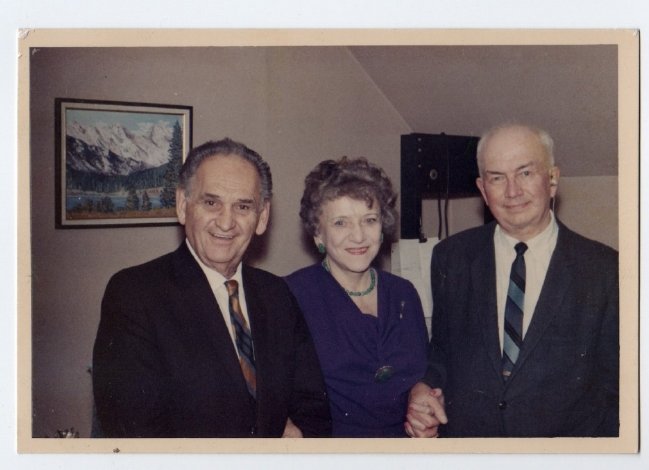
The photograph below features the American tenor Mario Chamlee, his wife Ruth, and William H. Seltsam. It is noteworthy that Seltsam had a hearing problem and his hearing aid can be seen in this photograph. Had he played his records too loudly?
He discontinued the IRCC publication of 78-RPM records in 1954, and he subsequently released over thirty long-playing records containing a few original recordings and a large number of historical reissues. They are listed, but not detailed, in this discography.
To summarize: William Seltsam seems to have been motivated by a genuine enthusiasm for records made at the beginning of the century, and he does not seem to have been attempting to get rich from his efforts. It was clearly a labor of love.
The Historic Record Society
William Speckin, Director
Chicago, Illinois
Imitation, being the sincerest form of flattery, William Speckin of Chicago, Illinois, formed the Historic Record Society in 1937, and he also made arrangements to have pressings made by major recording companies. He had his own distinctive labels which featured the Victor red and gold style of labels highlighted in reverse. However, some of the companies he dealt with attached their own labels to his reissues. He was also successful in having artists autograph labels on some of his releases. In almost every respect he was emulating the IRCC model.
For some unknown reason he was frequently disappointed by the record companies. He would request records that were never delivered to him, and there are quite a few catalog numbers that he skipped and which we included in the discography. We know that he had plans for many of those numbers and that copies of unused labels, some autographed, are in the hands of a few collectors.
At some point Mr. Speckin also started transcribing original records and many of them are unsatisfactory transfers. In fairness to Mr. Speckin and Mr. Seltsam, the equipment required to make good transfers from old records did not exist in the 1930s and 1940s. Making copies of cylinders was especially challenging. Variable speed record players and properly sized styli did not exist either, so collectors were not able to hear some of these artists very clearly, or in pitch.
Allan Sutton, in his book “Recording in the Thirties” discusses some of the controversy surrounding the transcribed recordings, especially those recorded in live Metropolitan Opera performances by Lionel Mapleson. They were scratchy, out of pitch and the performers probably would not have approved of them. Nonetheless, they are interesting as historical artifacts. Nellie Melba on stage allegedly sounds much better than the nervous Nellie who made recordings in a studio.
The frustrating part of compiling these discographies was our uncertainty about the sources of many of the records. Neither organization documented the matrix numbers, dates, sites or even the accompaniments on most of the HRS and IRCC records. We actually had to listen to many of them to determine accompaniments. We contacted many collectors for their help in finding matrix data, and we often found somebody somewhere who had that one bit of missing data for quite a few of the records.
Did we make mistakes? Probably. We often relied on discographies that were published forty or fifty years ago, and some of those discographers may have been making assumptions, especially about dates and alternative releases. We welcome any corrections that can be documented.
COMMENTS ABOUT THE DISCOGRAPHIES
A large number of companies produced the records listed in these discographies. Some produced cylinders, others produced discs, and some produced both types of recording. Record companies identify their recordings internally with matrix numbers, and commercially with catalog numbers. A matrix number is akin to a finger-print. It was only used once and it identifies a specific recording.
Once a matrix was recorded the companies would produce commercial copies of records with catalog numbers, often with many different catalog numbers over the years. They identified single-or double-sided discs, and it was not unusual for different countries to issue the same matrix with catalog numbers of their own. In some cases, the catalog number was the same as the matrix number.
If you are confused, imagine trying to account for thousands if records produced by many companies in many different countries in the first fifty year of the Twentieth Century. Very few of those companies shared matrix data such as the date the records were made, or where they were made. Fortunately, some of the information was actually embossed on the surface of some of the records in the space next to the label.
One of our more daunting problems was identifying the accompaniment on each record. For some reason neither HRS or IRCC printed that information of very many of their labels, and discographers in the past did not have access to, or simply ignored that information. So, we listened to each copy of each recording and we documented piano or orchestral accompaniments as well as indicating which recordings were introduced by a speaker.
Fortunately, some of the artists on these recordings had been featured in various publications and we were able to compare the data compiled by earlier discographers with our own findings. We were not always able to verify the date that a record was made, but we did have a very good idea of when the records first appeared in record catalogs.
Most of these records were recorded acoustically. Cylinders and some discs were recorded using a “hill-and-dale” process in which the recording stylus vibrated up and down in the groove being recorded. Other companies used a “lateral” process in which the recording stylus vibrated back and forth in the groove. The acoustical process required performers to stand at varying distances from the wide end of a horn shaped like a megaphone. At best it was a crude process and of relatively low fidelity.
To make things worse the discs were recorded at a wide variety of speeds even though the companies often recommended that the public play the records at 78 revolutions per minute. Fortunately, mechanical record players could be adjusted to play a record in the pitch at which it was recorded. There was an assumption that the owner of the record knew what that pitch may have been. After 1925, electrically driven record players were set at 78-RPM and could not be adjusted. People playing the older records needed the older machines.
Record companies also recommended that the needle used to play a record only be used once. Very few people followed that rule and the damage done to the groove could not be repaired. To add to that problem, grooves had different depths and widths. The materials used to produce a record varied greatly and some of them were bumpy, soft or noisy. One can often hear the needle hissing in the groove when an antique record is played.
In 1913, the Victor Company standardized their groove dimensions, but not all companies did that. In 1925 almost all companies agreed to the 78-RPM standard for record speed. This speed was ideal for the newly introduced electrical recordings made using microphones instead of horns, and which produced a far better level of fidelity. As was suggested above, the problem for people with the older type of record was that the new record players were set at 78-RPM and could not be adjusted to make corrections in pitch.
William Seltsam and William Speckin had to contend with all of the above mechanical factors when they attempted to transcribe early recordings onto 78-rpm records. In a few notes written by Seltsam we know that he either bragged about, or complained, that he had spent a great deal of money developing equipment to play and make transfers of the many types of record in his possession.
In conclusion, the early records produced by both organizations were pressed from original metal parts and they are vastly preferable as items sought by collectors. The autographs and photographs on some of the records add greatly to their value as artifacts. Many of the transcribed recordings are valuable as examples of the techniques employed by some very fine performers, but a few of them are unquestionably disappointing.
BIBLIOGRAPHY
Sutton, Allan, “Recording in the Thirties”, Mainspring Press, Denver, CO, 2011 – (Pages 127 to 134)
The Record Collector – All volumes – May 1946 to 2020, Broomfield, Chelmsford, Essex, England
Peel, Tom and John Stratton, “Seventy Years of Reissues”, Dundurn Press, Toronto and Oxford, 2001
Girard, Victor and Harold Barnes “Vertical Cut Cylinders and Discs”, British Institute of Recorded Sound, London, 1964
Quinn, Michael “Before the Echoes Fade”, Third edition - revised July 2020
Seltsam, William, 306 bulletins announcing International Record Collector’s Club releases from 1932 to 1954
We also used material compiled by John R. Bolig and John Milmo in their various discographies of Victor and His Master’s Voice Recordings. The Discography of America Historical Recordings site (DAHR) has made most of their work available on their website, and Allan Sutton has produced a number of Bolig’s discographies as books and as free discographies on his website. We are also appreciative of Larry Lustig and his encouragement as we worked on this research.